
Reactor for levulinic acid synthesis

Levulinic acid synthesis starts from biomass or carbohydrates (cellulose, starch, agricultural waste) and is an advanced and environmentally friendly chemical method involving hydrolysis and dehydration assisted by microwave irradiation and acid catalysts, reducing reaction times and energy costs compared to traditional techniques. Eprotech microwave reactors exploit the direct interaction of electromagnetic radiation to achieve uniform and extremely rapid dielectric heating. Dielectric heating transfers energy directly to the materials that absorb it, promoting rapid heating of the medium being treated. The product range can be sized according to the required production capacity. Operating conditions and benefits depend on the configuration, the reaction and the materials used.

Download the PDF brochure
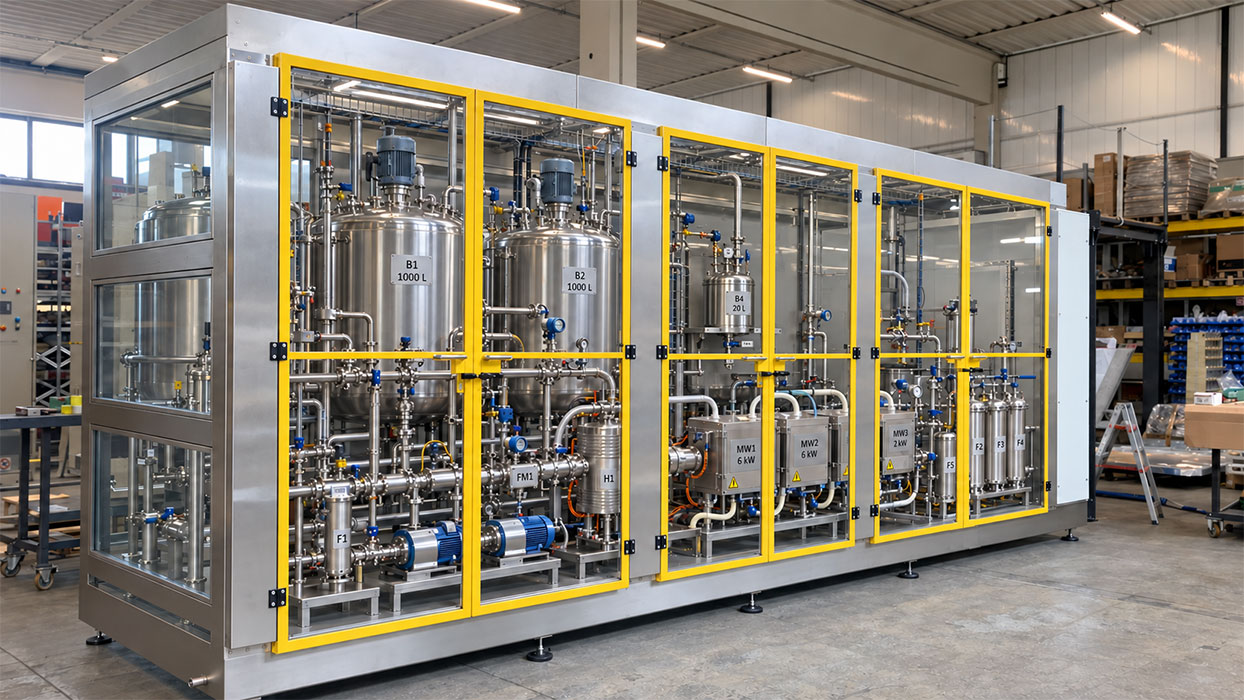
Eprotech reactor for levulinic acid synthesis
Technology
Microwave
Application
Reactor for levulinic acid synthesis
Configuration
Based on process requirements

Chemical reactions and thermal treatments of pumpable substances

The product range is designed for research, development and industrial applications requiring rapid heat transfer and controlled process conditions.

  • Chemical reactions and process development from laboratory to industrial scale.
  • Levulinic acid synthesis, with dedicated configurations.
  • Thermal processes involving pumpable liquid reagents, including viscous or aggressive reagents in the configurations provided.
  • Pasteurisation and sterilisation of pumpable substances, with the configuration to be defined according to the treatment.

How it works

Microwaves interact directly with materials capable of absorbing them and generate heat within the medium being treated. The technologies and operating conditions are combined according to the configuration.

  1. 01

    Process feeding

    Biomass or carbohydrates are fed into the process as pumpable liquid reagents, including highly viscous or aggressive ones.

  2. 02

    Microwave heating

    Electromagnetic radiation transfers energy directly to the materials that absorb it, generating uniform and rapid dielectric heating.

  3. 03

    Continuous treatment

    The process combines a microwave field, high temperature and pressure, and is configured for continuous operation.

Technological advantages

  • Rapid energy transferDielectric heating generates heat within the material that absorbs microwaves, reducing thermal inertia compared to conventional heat transfer.
  • Volumetric treatmentThe energy interacts with the volume of the absorbing material and can promote treatment uniformity, depending on the characteristics of the product and the process.
  • Process efficiencyIn certain applications, the use of microwaves can reduce treatment times and energy consumption.
  • Reaction qualityDepending on the reaction and the materials being treated, microwaves can limit thermal degradation and improve yield and selectivity.
  • Customisable configurationTechnologies and sizing are adapted to process requirements and the required production capacity.
  • Heat-based preservation processesIn pasteurisation and sterilisation applications, microwave heating can help limit physicochemical and organoleptic changes in the substances being treated. The results depend on the product and the process conditions.

Reactor for levulinic acid synthesis

Eprotech reactor for levulinic acid synthesis

Microwave reactor designed to convert glucose syrup into levulinic acid in a continuous process. The treatment combines a microwave field, high temperature and pressure, and is suitable for pumpable liquid reagents, including highly viscous or aggressive ones.

Reaction time3–4 min – Data referring to the conversion of glucose syrup into levulinic acid described in the source.
Maximum temperature250 °C
Maximum absolute pressure26 bar
Wetted surface materialsAISI 316L and PTFE
Maximum viscosity at the pumps1,400 mPa·s
Length of PTFE tube exposed to the microwave field250 m
Internal tube volume18 L
Maximum flow rate300 L/h
Microwave heating power14 kW
Maximum heat exchanger power25–30 kW
Mixer capacity1,000 L
Mixer heating power12 kW

The reaction time of 3–4 minutes refers to the application described. The maximum values reported do not constitute a guarantee of simultaneous performance under all process conditions.
Eprotech microwave reactors brochure cover

Download brochure

Download the brochure with descriptions, technical specifications and further information.

Click to download